Fetishguitars.com
  • Italian brands
    • Main italian brands
      • Bartolini
      • Carmelo Catania
      • Crucianelli
      • Eko
      • E-Ros
      • Excelsior
      • Galanti
      • Gemelli
      • Gherson
      • Masetti
      • Meazzi
      • Melody
      • Polverini
      • Sicily & Southern Italy
      • Wandrè
      • Welson
      • Zerosette
    • Eko
      • Eko homepage
      • GIEMMEI Guitars
      • Early Eko
      • The sparkling early sixties
      • The Years of the Glory
      • Eko in the seventies
      • The Final Years
      • Acoustic guitars
      • Eko or not
    • By region
      • Le Marche
      • Emilia Romagna
      • Lombardia, Piemonte , Veneto e Liguria
      • Sicily & Southern Italy
    • Misc & unknown
      • Hollowbodies
      • Squarish Gemmelloids
      • Unbranded guitars
      • unknown guitars with diamond inlays
  • Not Italian
    • Vintage electric guitars from Argentina
    • Hagström
    • Klira Twen Star basses
    • Spagna
    • Vox
  • Articles & Resources
    • Distributor Brands
    • Meazzi – Drums
    • La chitarra elettrica in Germania
    • Contacts, credits and help
  • Click to open the search input field Click to open the search input field Search
  • Menu Menu
  • Link to Facebook
  • Link to Instagram
  • Link to Mail

Welson

by Jack Marchal

The trade name Welson belonged to a Castelfidardo-based accordion making company founded by Orlando Quagliardi in 1921.

The company was among the very first ones to enter guitar manufacturing in the area. I’ve seen old Welson acoustic archtops, quite similar to mid-50’s German-made instruments, that looked as old as the earliest examples of Eko 100.

Its first electric solidbodies (1962-1964) make Welson appear to be some kind of a subsidiary to the Bartolini-Gemelli galaxy, though some details betray a care of seriousness that put those guitars apart and is typical of Welson. After 1964 the initial design evolves without discontinuity towards a second generation of generally sunburst finished solidbodies, equipped with more conventional controls than the previous pushbuttons stripes.

In this second half-decade the focus in the manufacturing program shifts gradually towards semi-acoustic archtops, mainly a classic single cutaway jazz box and a ES-335-inspired thinline, both being aimed at professional musicians. Welson takes at that time a status like being Italy’s Gibson. The instruments, acoustics included, are brandmarked with some kind of austere luxury ugliness (just like Gibsons indeed).

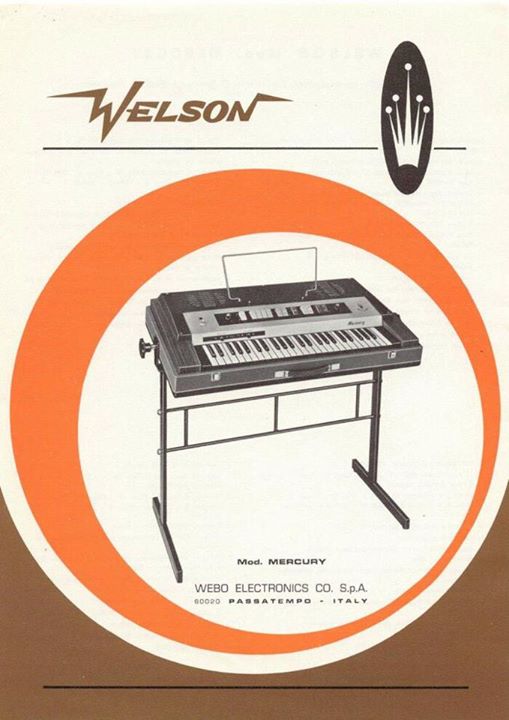
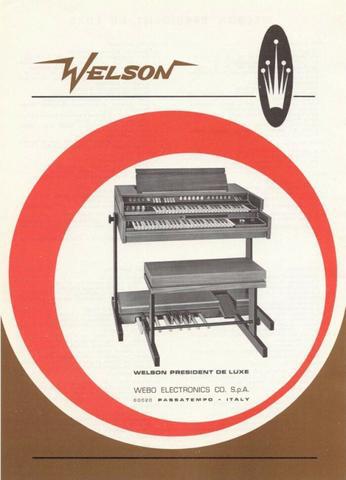
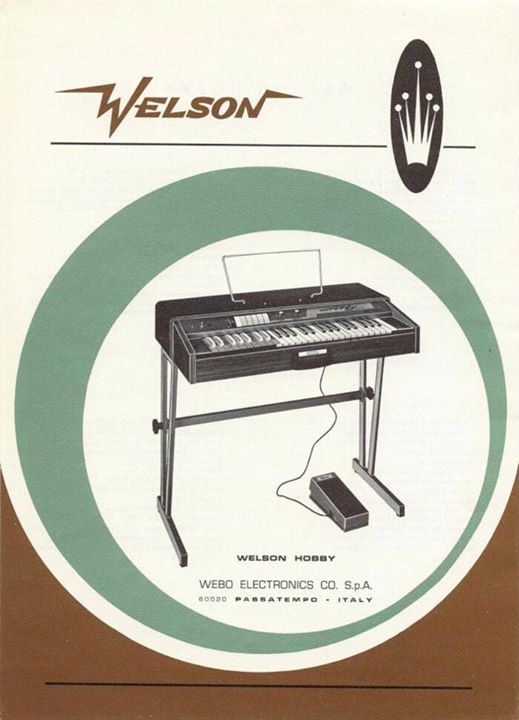
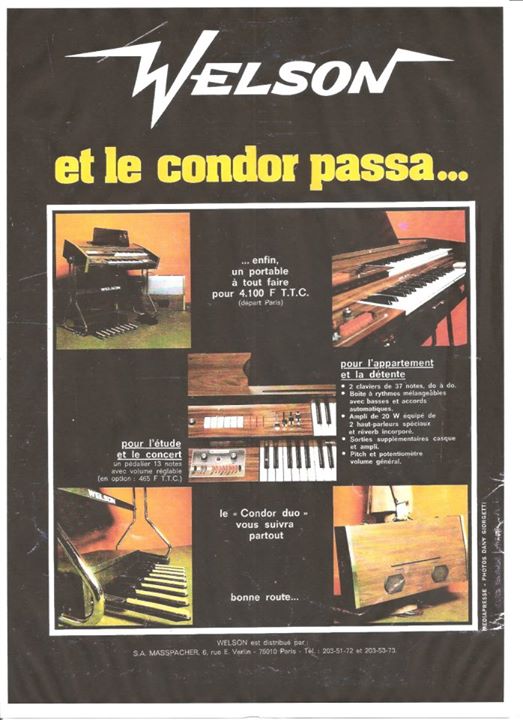
In the early 70’s Welson made LesPaul and SG copies, as could be expected, then specialized on electronic keyboards. However some kind of custom shop was maintained throughout the 70′s to supply high quality boutique guitars. The Quagliardi company ceased activity in 1981.
This maker used mainly two pickup models during the 60′s. First were used the same twin coil items as Crucianelli, Bartolini, Gemelli and others, with just another packaging (Welson choose a sort of wafer or caterpillar embossed metal cover), then after 1967 humbuckers, easy to identify with their six screws and the two part magnetic bar, of truly exceptional quality (no noise, high output). Here again the comparison with Gibson comes to mind.

While Quagliardi and Welson accordions never were really common, Welson guitar production reached a large scale, in Italy second only to Eko and Crucianelli. But rather than struggling for 1 percent sales share in music shops of Milan or Rome the company preferred to concentrate on remote markets, taking advantage of the image of near professional seriousness associated to its instruments. Welson guitars are easy to find in France, Belgium and Holland, they are not rare in the rest of the Western world… with the ironic exception of Italy, where they are virtually ignored.
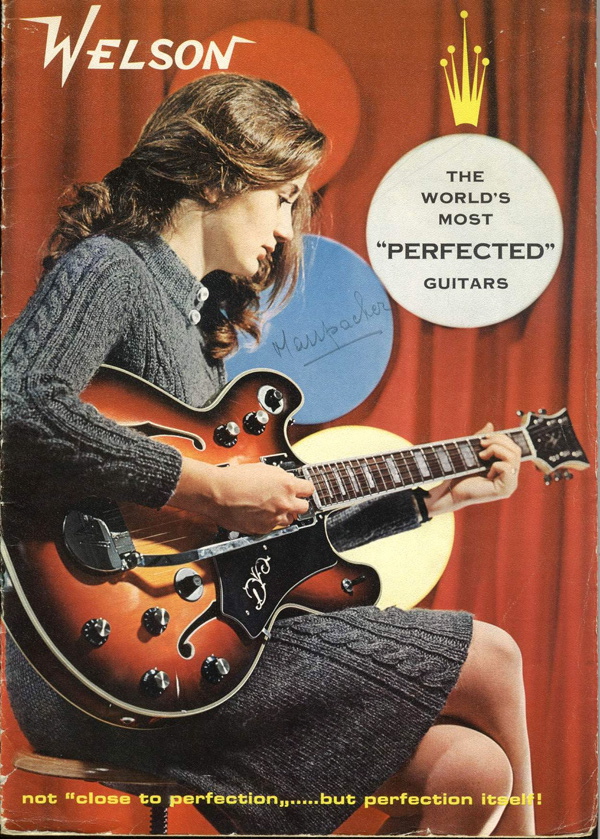
The company gained acknowledgement from highly respected names in the industry such as Dynacord and Wurlitzer. The whole electric range was marketed in Germany in the years 1965-66 under the Dynacord logo. In 1967-69 Welson had with the American company Wurlitzer a similar agreement that included the acoustic range, while violin-shaped guitars and basses were distributed in USA under the Orpheum brand. There is remarkably not any difference between Welson branded instruments and the Dynacord, Wurlitzer and Orpheum versions.

The early marble and glitter guitars were also marketed in the US of A. under the Beltone brand, and special versions were made for Hopf of Germany. In 1964 a small batch of primitive single-cutaway jazz boxes was supplied to Vox UK.

Towards the end of the decade a violin-shaped series of guitars and basses was manufactured for the American distributor Orpheum while modified versions were made for the Italian company Meazzi, that also included in its range various Welson made acoustics.

The trade name Welson belonged to a Castelfidardo-based accordion making company founded by Orlando Quagliardi in 1921. The company was among the very first ones to enter guitar manufacturing in the area. I’ve seen old Welson acoustic archtops, quite similar to mid-50’s German-made instruments, that looked as old as the earliest examples of Eko 100.

Its first electric solidbodies (1962-1964) make Welson appear to be some kind of a subsidiary to the Bartolini-Gemelli galaxy, though some details betray a care of seriousness that put those guitars apart and is typical of Welson. After 1964 the initial design evolves without discontinuity towards a second generation of generally sunburst finished solidbodies, equipped with more conventional controls than the previous pushbuttons stripes.

In this second half-decade the focus in the manufacturing program shifts gradually towards semi-acoustic archtops, mainly a classic single cutaway jazz box and a ES-335-inspired thinline, both being aimed at professional musicians. Welson takes at that time a status like being Italy’s Gibson. The instruments, acoustics included, are brandmarked with some kind of austere luxury ugliness (just like Gibsons indeed).

In the early 70’s Welson made LesPaul and SG copies, as could be expected, then specialized on electronic keyboards. However some kind of custom shop was maintained throughout the 70′s to supply high quality boutique guitars. The Quagliardi company ceased activity in 1981.

This maker used mainly two pickup models during the 60′s. First were used the same twin coil items as Crucianelli, Bartolini, Gemelli and others, with just another packaging (Welson choose a sort of wafer or caterpillar embossed metal cover), then after 1967 humbuckers, easy to identify with their six screws and the two part magnetic bar, of truly exceptional quality (no noise, high output). Here again the comparison with Gibson comes to mind.

While Quagliardi and Welson accordions never were really common, Welson guitar production reached a large scale, in Italy second only to Eko and Crucianelli. But rather than struggling for 1 percent sales share in music shops of Milan or Rome the company preferred to concentrate on remote markets, taking advantage of the image of near professional seriousness associated to its instruments. Welson guitars are easy to find in France, Belgium and Holland, they are not rare in the rest of the Western world… with the ironic exception of Italy, where they are virtually ignored.

The company gained acknowledgement from highly respected names in the industry such as Dynacord and Wurlitzer. The whole electric range was marketed in Germany in the years 1965-66 under the Dynacord logo. In 1967-69 Welson had with the American company Wurlitzer a similar agreement that included the acoustic range, while violin-shaped guitars and basses were distributed in USA under the Orpheum brand. There is remarkably not any difference between Welson branded instruments and the Dynacord, Wurlitzer and Orpheum versions.

The early marble and glitter guitars were also marketed in the US of A. under the Beltone brand, and special versions were made for Hopf of Germany. In 1964 a small batch of primitive single-cutaway jazz boxes was supplied to Vox UK.

Towards the end of the decade a violin-shaped series of guitars and basses was manufactured for the American distributor Orpheum while modified versions were made for the Italian company Meazzi, that also included in its range various Welson made acoustics.

  • WELSON
  • The History
  • La storia
  • Early Solid-Bodies
  • Vedette and the like
  • In the ES-335 style
  • Florentine
  • Semi-acoustic oddities
  • Single cutaway jazz boxes
  • Violin-Shaped monstruosities
  • Les Paul and SG Copies
  • Flat top acoustics
  • Orpheum – Maurice Lipsky
  • Abramusic
  • Argentina
  • Ariston – Bagnini
  • Ariston – Rex
  • ASM Arrigoni
  • Baldwin 700 series
  • Bartolini
  • Bartolini, Fratelli
  • Beat
  • Bigson
  • Binson
  • Buxom
  • Calace
  • Caponnetto
  • Carini
  • Carmelo Catania
  • Clan
  • Clarissa
  • Contessa
  • Giuseppe Cervi
  • Crucianelli
  • D’scala
  • Dallas
  • Davoli – Krundaal
  • Dega Morbidoni
  • Dynelectron
  • E-Ros
  • Eko
  • Elka – Crumar
  • Emilia Romagna
  • España – Buegeleisen & Jacobson
  • Eston – Lamberti
  • Estudiantina
  • Excelsior
  • Ferrarotti
  • Framez
  • Galanti
  • GEM
  • Gemelli
  • Gherson
  • GIEMMEI Guitars
  • Ginson
  • GIS
  • G&B Giustozzi Bompezzo
  • Godwin – Sisme
  • Goya Galanti
  • Goya Zerosette
  • Hagström
  • Harold – Jackson
  • Hermann
  • Hertz
  • Hohner HG
  • Indelicato Contarino
  • JG – Juliett
  • Klira Twen Star basses
  • Kroma
  • Layolo
  • Marinucci
  • Masetti
  • Meazzi
  • Melody
  • Messaggerie Musicali
  • Misc & unknown
  • Monzino – Garlandini
  • Moreschi
  • Don E. Noble
  • Olivieri
  • Orpheum – Maurice Lipsky
  • Pas Record
  • Pellegrini
  • Enrico Piretti
  • Polverini
  • Rayhorn 0 Seven
  • Recina Guitars
  • Silvestri
  • Solo Venanzini
  • Steelphon
  • Vox
  • Wandré
  • Welson
  • Wurlitzer
  • Zabella
  • Zerosette
FETISHGUITARS © 2003-2019 CN.AR750106-65
  • Link to Facebook
  • Link to Instagram
  • Link to Mail
  • Home
  • Help & Contacts
  • Privacy Policy
Scroll to top Scroll to top Scroll to top

Questo sito non fa uso dei cookies di profilazione per i quali è richiesto il consenso del navigatore.

OKLearn more

Cookie and Privacy Settings


How we use cookies

We may request cookies to be set on your device. We use cookies to let us know when you visit our websites, how you interact with us, to enrich your user experience, and to customize your relationship with our website.

Click on the different category headings to find out more. You can also change some of your preferences. Note that blocking some types of cookies may impact your experience on our websites and the services we are able to offer.

Essential Website Cookies

These cookies are strictly necessary to provide you with services available through our website and to use some of its features.

Because these cookies are strictly necessary to deliver the website, refusing them will have impact how our site functions. You always can block or delete cookies by changing your browser settings and force blocking all cookies on this website. But this will always prompt you to accept/refuse cookies when revisiting our site.

We fully respect if you want to refuse cookies but to avoid asking you again and again kindly allow us to store a cookie for that. You are free to opt out any time or opt in for other cookies to get a better experience. If you refuse cookies we will remove all set cookies in our domain.

We provide you with a list of stored cookies on your computer in our domain so you can check what we stored. Due to security reasons we are not able to show or modify cookies from other domains. You can check these in your browser security settings.

Google Analytics Cookies

These cookies collect information that is used either in aggregate form to help us understand how our website is being used or how effective our marketing campaigns are, or to help us customize our website and application for you in order to enhance your experience.

If you do not want that we track your visit to our site you can disable tracking in your browser here:

Other external services

We also use different external services like Google Webfonts, Google Maps, and external Video providers. Since these providers may collect personal data like your IP address we allow you to block them here. Please be aware that this might heavily reduce the functionality and appearance of our site. Changes will take effect once you reload the page.

Google Webfont Settings:

Google Map Settings:

Google reCaptcha Settings:

Vimeo and Youtube video embeds:

Other cookies

The following cookies are also needed - You can choose if you want to allow them:

Privacy Policy

You can read about our cookies and privacy settings in detail on our Privacy Policy Page.

Privacy Policy
Accept settingsHide notification only